Performances
Greek National Opera Orchestra brings varied gifts to Carnegie Hall
It’s always an occasion when an ensemble makes their first appearance […]
A staged Reich masterpiece makes for a memorable night at Park Avenue Armory
Steve Reich turned 90 on October 3 but we are the […]
Carnegie’s Mahler cycle off to an unsettled start with a Fifth Symphony of anticlimaxes
One of the biggest events on this season’s classical music calendar […]
Berlin Philharmonic brings fresh conviction to familiar Brahms and Strauss
Never let it be said that the Berlin Philharmonic shies away […]
Alternate cast keeps the romance and comedy alight in Met’s “Bohème”
A fresh Mimì joined the revolving cast of Bohemians in the […]
Articles
Top Ten Performances of 2025
1. Mahler: Symphony No. 7. Gustavo Dudamel/New York Philharmonic Gustavo Dudamel […]
Critic’s Choice
Music of Prokofiev, Still, Ginastera, Blache. Sphinx Virtuosi. October 17. The […]

Concert review
Orpheus pleases with Mozart, Schumann and new work, all for free at Carnegie
Carnegie Hall was conceived over a century ago as the crossroads of democracy, and still waters and tends its reputation for inclusiveness in programming.
At the same time, it is the place you famously have to practice, practice, practice to get to, as well as listen, listen, listen to properly appreciate what happens there, and pay, pay, pay for the privilege.
As for 54 years, the conductor-less Orpheus Chamber Orchestra, that product of the iconoclastic early 1970s, was having it both ways Saturday afternoon. It threw open Carnegie’s doors, giving away 2,700 tickets to the first of its free-admission “Orpheus for All” concerts of the season. But it also refused to dumb down its offerings of Mozart, Schumann and an ear-challenging contemporary piece for its presumably less “select” audience.
It must be said, though, that entering the hall and seeing the setup for the first piece, Brian Raphael Nabors’s Groove Studies—sober-looking chairs and music stands surrounding a gleaming drum kit—one expected some populist fare.Reading that the composer was the son of a pastor and a church musician, “steeped in the sounds of soul, funk, gospel, jazz, and Black marching bands,” brought thoughts of at least a dialogue between the church and the street corner, maybe even some Ivesian collisions.
But Nabors also sports a doctorate from the University of Cincinnati College Conservatory of Music. His goal, as explained in the program, was not just to lay down a steady groove as a frame for his composition, but to introduce multiple grooves as the material for composition themselves. Again, a provocative idea, maybe a little complicated.
The piece itself—an Orpheus commission composed this year and having its New York premiere Saturday–began with a steady quarter-note pulse that soon hit some bumps in the road. The music became rhythmically complex as advertised, and explored a variety of timbres from sarcastic high winds to mellow string tremolo to ghostly attenuated chords. But it all was somewhat “sicklied o’er with the pale cast of thought,” at least until the bass drum, wood block and cowbell had their noisy say near the end.
The able percussionist who gently steered the piece’s metrical complexities and shifting timbres, and was accorded a solo bow at the end, went unnamed in the program, owing to the common practice of listing only regular members of the orchestra by name, not “ringers” hired for one or two performances only. NYCR’s query of sources for his name is ongoing at time of posting.
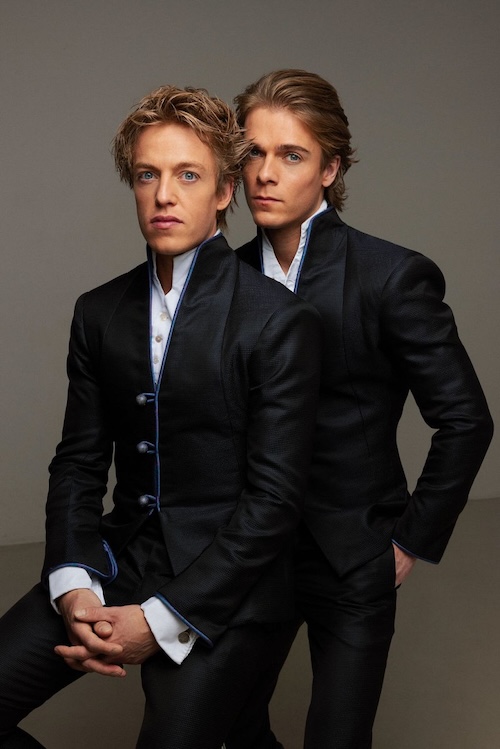
In keeping with putting on a quality program for their free-admission audience, Orpheus engaged the star Dutch piano duo of Lucas and Arthur Jussen, brothers in their 20s whose good looks are matched with brilliant musicianship, for Mozart’s Concerto for Two Pianos in E-flat Major, K. 365.
The orchestra particularly touts its reputation as partners in Mozart concertos, citing Grammy-winning recordings, but on this occasion it sounded a little unclear rhythmically and out of sync, especially the winds. In the opening pages (perish the thought) someone with a baton might have helped them pull together and find a firmer sense of direction.
For its part, the sibling duo played with impeccable coordination and fluency. Mozart’s distinctive themes could have projected a bit more from the shapely swirls of notes, but the composer’s charm and dazzle were well represented to the newcomers and aficionados in the audience.
(Ignoring strict concert etiquette, listeners applauded after every movement all evening. The pianists smiled and nodded; the orchestra sat stiffly and waited for it to end.)
A Mozart Andante needs more drama and sing than this ensemble gave the concerto’s second movement Saturday, although the soloists built well off each other in ever-more-expressive elaborations of their cantabile line. In the finale, the pianists again gave a lesson in coordination and witty dialogue, culminating in a rip-roaring duo cadenza that so cunningly created the illusion of improvisation on the spot that the audience burst into applause before it was over.
The pianists played an encore, a madcap fantasia for two pianos on Johann Strauss II’s Die Fledermaus, presumably the one by Abram Chasins or portions thereof. But for all the millions of notes in the encore, it was that Mozart cadenza that was the wow of the evening.
Orpheus has embarked on a series of commissions to arrange works of Romantic chamber music to fill a historic gap in the chamber orchestra repertoire between the Classical era and the twentieth century. The latest of these, Robert Schumann’s Piano Trio No. 1 in D minor, Op. 63, arranged this year as a chamber symphony by Christopher Theofanidis, made its bow Saturday night.
Schumann himself, who tended to concentrate on piano music, songs, chamber music, etc. one genre at a time, had little or no history of arranging or recasting his ideas in different media. One composer who did just that was Schumann’s young protégé Johannes Brahms, and it’s perhaps no coincidence that arranger Theofanidis seemed often to take Brahms’s piquant use of wind-string doublings and high-low contrasts as the model for mid-Romantic-era German orchestration.
Unfortunately, some of the thick orchestration of Schumann’s own symphonies seemed to have rubbed off on the arranger as well. A feeling of “everybody playing all at once all the time,” though not literally true, still crowded on the listener’s ear after a while.
But give the arranger credit for applying a percussive pulse with the timpani in the first movement, so one didn’t miss the piano so much. Similarly, the scherzo was rescued from a miasma of swirling rapid notes by a sturdy one-to-a-bar swinging rhythm.
The slow movement was the high point of this “symphony,” beginning with a gorgeous clarinet solo beautifully orchestrated with strings, followed by similar moments for flute, horn, and oboe, and winding down to a hush so profound that the audience forgot to applaud.
The finale strode happily along, but as for the indication “Mit Feuer,” it was hard for an orchestra to strike the kind of sparks that two scratchy bows on strings and a box full of hammers can. Nevertheless, by the end they were giving it all they had, stringing crescendos together into a vigorous coda that pleased all present.
Orpheus Chamber Orchestra, with pianist Isata Kanneh-Mason, will perform works by Handel, Mozart, Katie Jenkins, and Haydn, 7:30 p.m. Nov. 17 in Carnegie’s Zankel Hall. carnegiehall.org
Calendar
October 18
Deborah Buck, violinist
Orli Shaham, pianist
Copland: Two Piece […]
News
Critic’s Choice
Music of Morton Feldman and Earle BrownGraphic Content FestivalSeptember 11-November 21 […]
A complete Ring and Mahler cycle to highlight Carnegie Hall’s 2026-27 season
Carnegie Hall’s 2026-2027 schedule promises some of the most substantial and […]